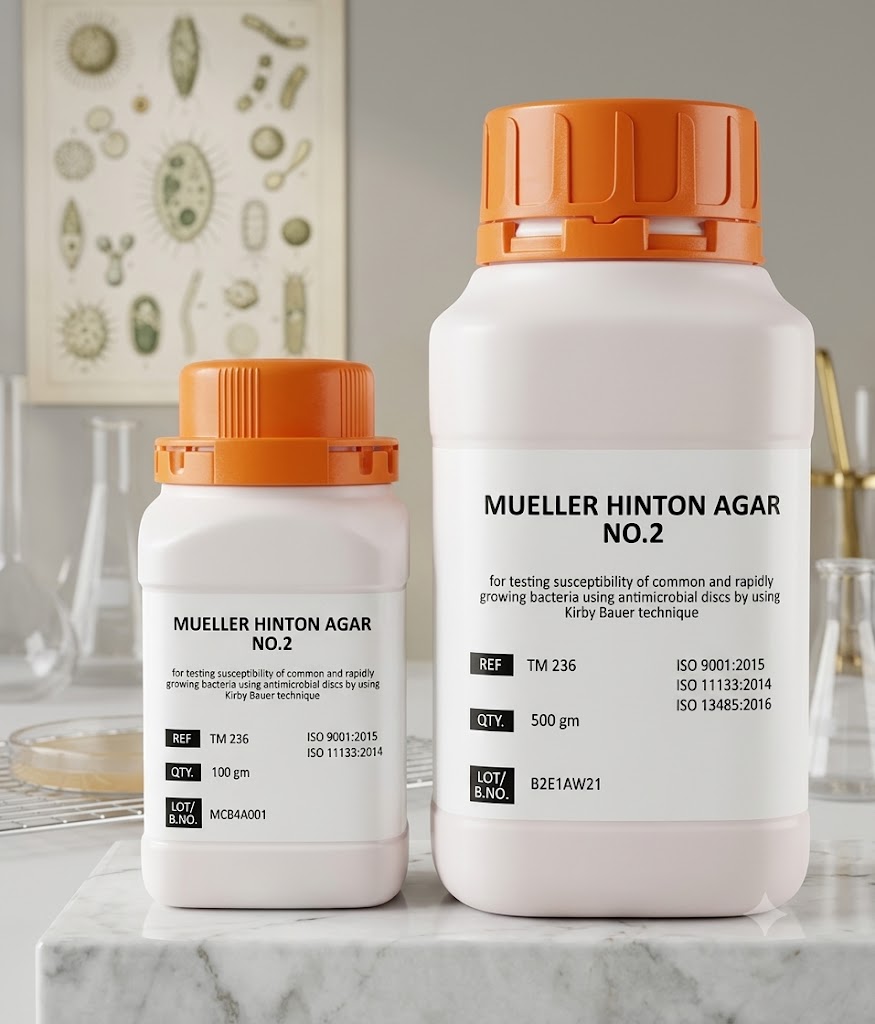
Reference · GR-C-TM 236
MUELLER HINTON AGAR NO.2
- Category
- Consumables
- Price
- F CFA 46,825
Certifications
IVD (For In Vitro Diagnostic Use)GMP (Good Manufacturing Practices Certified)
The goal of susceptibility test is to predict through an in vitro assessment the likelihood of successfully treating a patient's
infection with a particular antimicrobial agent. The Mueller Hinton formulation was originally developed as a simple,
transparent agar medium for the cultivation of pathogenic Neisseria species. Other media were subsequently developed
hat replaced the use of Mueller Hinton Agar for the cultivation of pathogenic Neisseria species, but it became widely used
in the determination of sulfonamide resistance of gonococci and other organisms. Mueller Hinton Agar is now used as a
test medium for antimicrobial susceptibility testing. Mueller Hinton Agar is recommended for the diffusion of
antimicrobial agents impregnated on paper disc through an agar gel as described in NCCLS (National Committee for
Clinical Laboratory Standards), now CLSI (Clinical and Laboratory Standards Institute) Approved Standard
Technical specifications
| Voici la traduction en français de votre texte, adaptée aux standards des protocoles de microbiologie. | |
|---|---|
| Traduction scientifique | |
| L'infusion de cœur de bœuf et l'hydrolysat acide de caséine fournissent les composés azotés, le carbone, le soufre et d'autres nutriments essentiels. L'amidon agit comme un colloïde protecteur contre les substances toxiques présentes dans le milieu. L'hydrolyse de l'amidon libère du dextrose, qui sert de source d'énergie. Ces ingrédients sont sélectionnés pour leur faible teneur en thymine et en thymidine, déterminée par les valeurs de CMI (Concentration Minimale Inhibitrice) pour Enterococcus faecalis avec le sulfaméthoxazole-triméthoprime. | |
| Les concentrations en ions calcium et magnésium sont ajustées afin de fournir les quantités recommandées par le CLSI, permettant ainsi d'obtenir les valeurs de CMI correctes avec les aminoglycosides et Pseudomonas aeruginosa. La procédure de Kirby-Bauer repose sur la diffusion en gélose de substances antimicrobiennes imprégnées sur des disques de papier. |